
B-BBEE Certificate Compliance Services 2026: What South African Businesses Must Get Right This Year
Walk into any procurement meeting with a lapsed B-BBEE certificate and the conversation ends before it begins. On the East Rand, where manufacturing contracts, logistics tenders, and government supply agreements move quickly, a company’s B-BBEE certificate compliance status is often the single document that determines whether a bid is read or set aside. In 2026, with the B-BBEE Commission continuing to tighten its enforcement posture and SANAS-accredited rating agencies operating under more rigorous audit standards, the cost of a weak or expired certificate has never been higher.
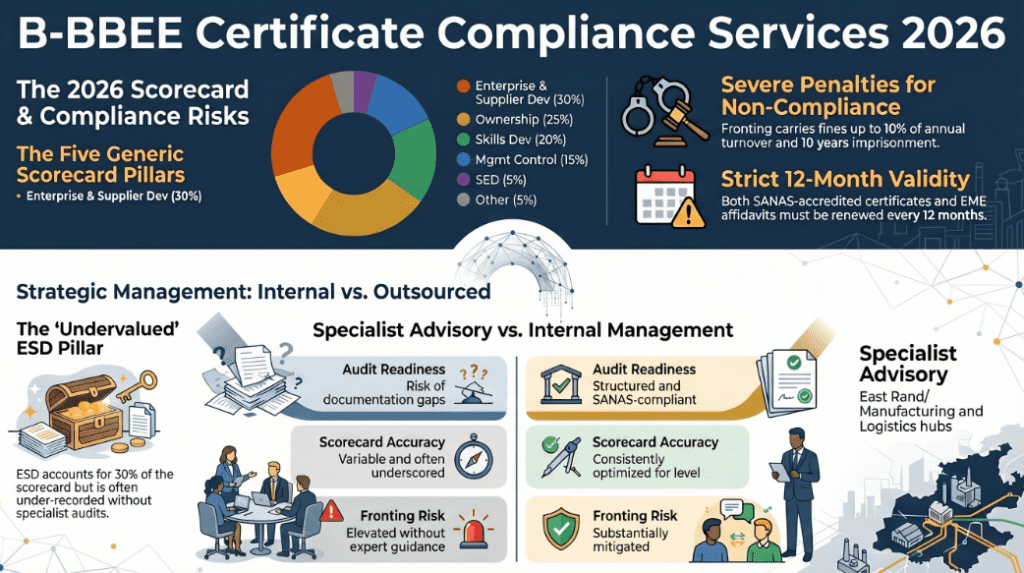
South Africa’s Broad-Based Black Economic Empowerment framework, governed by the B-BBEE Act and the Codes of Good Practice, requires every business seeking state contracts or operating in regulated sectors to demonstrate a valid, verified compliance level. According to the B-BBEE Commission’s enforcement guidance, misrepresenting B-BBEE status (a practice known as fronting) carries fines of up to 10% of annual turnover and criminal prosecution of up to 10 years. Certificates issued by SANAS-accredited agencies are valid for 12 months; EME affidavits must be renewed annually. This article explains how B-BBEE certificate compliance services work, what your business category requires, and how to choose between managing it internally or engaging a specialist for 2026.
Why the East Rand’s Business Environment Makes B-BBEE Compliance Non-Negotiable
The East Rand corridor is home to a dense concentration of suppliers, manufacturers, and service providers competing directly for state-linked procurement. Ekurhuleni Metropolitan Municipality, which governs the bulk of this region, applies B-BBEE compliance criteria to its supplier database and contract awards. Businesses operating out of Boksburg, Germiston, Benoni, and Springs face a marketplace where a competitor’s Level 2 certificate can displace a Level 4 holder from a preferred supplier list overnight.
The B-BBEE Commission’s Annual Report series has consistently noted that non-compliance and fronting remain concentrated in the SME sector, where internal compliance capacity is thin. The South African Institute of Chartered Accountants (SAICA) has highlighted, in published guidance, that many small businesses misclassify their entity type and apply the wrong scorecard, resulting in verification certificates that do not survive audit scrutiny. For the East Rand business owner managing payroll, employment equity, and HR obligations simultaneously, the administrative complexity of a B-BBEE scorecard is a genuine operational burden, not a theoretical one.
Managing B-BBEE Compliance: Internal Management vs Specialist Advisory
Option A: Internal B-BBEE Compliance Management
Internal management means appointing a staff member to track scorecard performance across all five pillars, maintain supporting evidence files, and manage the annual verification process with a SANAS-accredited rating agency.
Pros:
- Direct, immediate access to internal records and financial data
- No external advisory fees for routine scorecard tracking
- Staff familiarity with the business’s ownership structure and supplier relationships
Cons:
- Requires continuous training as Codes of Good Practice and sector-specific codes are amended
- Risk of incorrect entity classification (EME, QSE, or Generic) without specialist guidance
- Evidence files often fail audit scrutiny due to formatting or documentation gaps
- Skills Development and Enterprise and Supplier Development pillars are frequently underscored through missed opportunities
Option B: Outsourced B-BBEE Specialist Advisory
Outsourced advisory means engaging a qualified B-BBEE specialist to conduct a scorecard diagnostic, identify optimisation opportunities, prepare audit-ready evidence files, and manage the verification process on your behalf.
Pros:
- Specialist knowledge of the Codes of Good Practice, sector codes, and SANAS requirements applied directly
- Strategic planning across all five pillars, including Skills Development spend and Ownership structures
- Audit-ready compliance files that survive SANAS-accredited agency scrutiny
- Proactive identification of learnerships, bursaries, and Enterprise and Supplier Development initiatives that improve the scorecard
Cons:
- Monthly retainer or project-based fee applies
- Requires initial information handover and onboarding process
- Ongoing communication needed to capture qualifying expenditure in real time
| Feature | Internal Management | Outsourced Specialist |
|---|---|---|
| Scorecard accuracy | Variable | Consistently optimised |
| Audit-ready evidence files | Risk of gaps | Structured and compliant |
| Sector code expertise | Limited | Comprehensive |
| Skills Development optimisation | Often missed | Proactively maximised |
| Fronting risk | Elevated without guidance | Substantially mitigated |
The Annual Renewal Obligation That Erodes Your Competitive Position
A B-BBEE verification certificate is valid for 12 months from the date of issue. An EME affidavit carries the same 12-month validity. The moment either document expires, your business drops off preferred supplier lists, becomes ineligible for state contract bids, and loses any procurement advantage the certificate previously provided. Recovery takes time: the verification process itself can take several weeks, and a poorly prepared evidence file extends that timeline further.
The cost of inaction is measurable. A Level 2 business that allows its certificate to lapse mid-tender cycle may lose a contract to a Level 4 competitor simply because its documentation was not current. Businesses that maintain a structured annual compliance programme avoid this exposure and deliver three direct commercial benefits:
- Continuous eligibility for state and corporate procurement opportunities throughout the year
- A scorecard that improves progressively as strategic interventions compound across Skills Development and Enterprise and Supplier Development pillars
- An audit-ready evidence file that reduces verification turnaround time and agency fees
Why Professional B-BBEE Support Delivers More Than a Certificate
Assigning B-BBEE management to an existing finance or HR administrator seems cost-efficient until the verification agency returns a qualified certificate, or worse, until the B-BBEE Commission initiates a fronting inquiry. The intersection of ownership structures, management control representation, qualifying Skills Development spend, and the supplier development measurement criteria creates a technical landscape that generalists regularly misread.
VCA Consulting provides B-BBEE advisory services across Gauteng, with particular depth in the East Rand market. When selecting a compliance partner, red flags include vague scorecard projections without data, no written engagement agreement, and advisors who cannot name the specific sector code applicable to your industry. A credible specialist will provide:
- A full scorecard diagnostic identifying your current level and all available optimisation points
- Structured support across learnerships and skills development programmes that directly improve your Skills Development pillar score
- An audit-ready evidence file prepared to SANAS standards, with clear documentation trails for every scorecard element
The Black Economic Empowerment framework rewards deliberate, strategic compliance over reactive certificate chasing. Businesses that treat their scorecard as a planning tool, rather than an annual obligation to minimise, consistently achieve higher levels and stronger procurement positions. VCA’s HR and IR services also connect directly to Management Control and Skills Development scoring, which means clients working across the full service offering gain scorecard benefits that extend well beyond the certificate itself.
The Scorecard Element Most Businesses Undervalue
Enterprise and Supplier Development carries 30% of the Generic Scorecard weighting, making it the single highest-impact pillar. Yet many businesses leave significant points on the table by failing to formalise their existing relationships with black-owned suppliers. Purchases already being made from qualifying suppliers often go unrecorded simply because no one has mapped the supply chain against B-BBEE classification criteria. A structured supplier audit, conducted at the start of the compliance year, frequently reveals that a business is already performing better on this pillar than its current certificate reflects. Correcting this without specialist input is difficult; correcting it with the right guidance is a straightforward scorecard improvement that costs nothing beyond the advisory fee.
Our Services | Contact Us | PAIA Annual Report 2026
The 2026 B-BBEE certificate compliance cycle rewards preparation, not last-minute verification requests. Businesses that maintain a current certificate, manage their scorecard strategically across all five pillars, and work with a specialist who understands sector codes and audit requirements will hold a durable procurement advantage. Those operating with lapsed certificates, incorrectly classified entity types, or evidence files that will not survive SANAS scrutiny face a competitive exposure that compounds with every tender cycle.
With Ekurhuleni’s procurement environment demanding rigorous compliance and the B-BBEE Commission enforcing fronting provisions with greater frequency, the time to address your scorecard position is before the verification window, not during it.
Is your B-BBEE certificate ready for the 2026 compliance cycle? Do not leave your procurement eligibility to chance. Book a Consultation or Request a Quote today from a qualified B-BBEE specialist.
Frequently Asked Questions
What is the difference between an EME affidavit and a B-BBEE verification certificate?
An EME affidavit applies to businesses with an annual turnover below R10 million and is a sworn commissioner of oaths declaration rather than a full verification; it carries the same 12-month validity but does not require a SANAS-accredited agency.
How often does a B-BBEE certificate need to be renewed?
B-BBEE verification certificates issued by SANAS-accredited rating agencies are valid for 12 months and must be renewed annually to maintain procurement eligibility and scorecard standing.
What happens if a business misrepresents its B-BBEE status?
Fronting, which includes any misrepresentation of B-BBEE compliance, is a criminal offence under the B-BBEE Act and can result in fines of up to 10% of annual turnover as well as imprisonment of up to 10 years for individuals involved.