
Employment Equity Act Plan for Businesses: What Designated Employers Must Do
Every business with 50 or more employees in South Africa is now legally required to maintain a current Employment Equity Act plan that aligns with sector-specific numerical targets set by the Department of Employment and Labour. The Employment Equity Act 55 of 1998, as amended by the Employment Equity Amendment Act of 2022 (effective 1 January 2025), marks the most substantial overhaul of workplace transformation legislation the country has seen in decades. VCA Consulting works with designated employers across Gauteng and beyond to develop, implement, and report on compliant EE plans before regulatory deadlines close in.
Key Takeaways
- Only employers with 50 or more employees qualify as designated employers under the 2025 amendments; the previous turnover threshold has been removed.
- Designated employers must adopt a five-year Employment Equity Plan covering the period 1 September 2025 to 31 August 2030.
- Sector-specific numerical targets now apply across 18 economic sectors, covering the top four occupational levels.
- The disability employment target has increased from 2% to 3% across all sectors.
- A Certificate of Compliance is mandatory for any employer seeking to do business with an organ of state.
- Non-compliance carries fines of up to 10% of annual turnover, exclusion from government contracts, and reputational risk.
Who Qualifies as a Designated Employer in 2025?
Before a business can begin drafting an Employment Equity Act plan, it must confirm whether it meets the revised definition of a designated employer. As of 1 January 2025, only employers with 50 or more employees fall under this classification, regardless of annual turnover. The previous threshold, which categorised smaller businesses as designated employers if their turnover exceeded a sector-specific figure in Schedule 4 of the Act, has been repealed entirely, according to DLA Piper.
Municipalities, organs of state, and employers designated through collective agreements remain subject to affirmative action obligations irrespective of headcount. For private sector businesses below the 50-employee threshold, the administrative burden of developing EE plans and submitting annual reports falls away, though the non-discrimination provisions in Chapter II of the Act still apply to every employer in South Africa.
South African labour law places the Employment Equity Act within a broader framework of workplace rights that all employers, designated or not, are expected to uphold.
What the Five-Year EE Plan Must Include
The 2025 Employment Equity Regulations, gazetted on 15 April 2025, require designated employers to develop and implement a five-year Employment Equity Plan spanning 1 September 2025 to 31 August 2030. According to DLA Piper’s analysis of the regulations, the plan must incorporate the sectoral numerical targets as its compliance benchmark rather than the employer’s own self-determined goals, which was the previous standard.
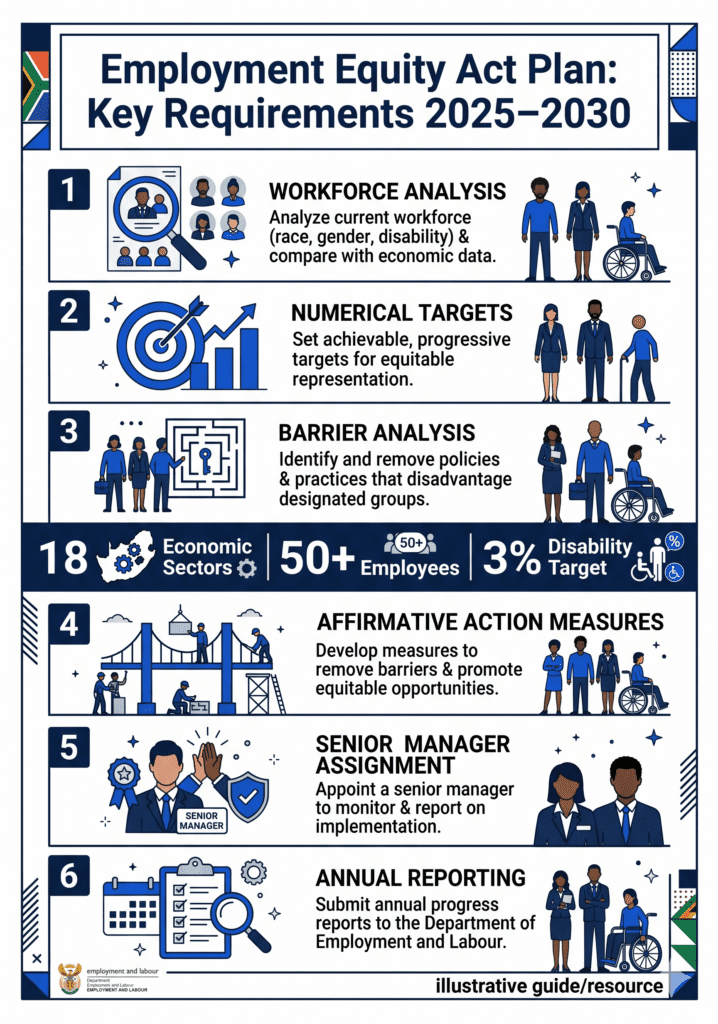
A properly constructed Employment Equity Act plan for businesses must address the following:
- Workforce analysis covering current representation of designated groups across all occupational levels.
- Numerical targets aligned to the applicable sector’s gazetted figures for Black people (African, Coloured, and Indian), women, and persons with disabilities.
- Barrier analysis identifying structural, procedural, or cultural factors that limit equitable representation.
- Affirmative action measures to address identified barriers, including recruitment practices, promotion pipelines, and development programmes.
- Responsibility assignment to one or more senior managers, as now required by labour inspectors under the amended Act.
- Employment Equity monitoring and reporting mechanisms tied to the annual submission cycle.
VCA Consulting’s employment equity consulting service covers each of these elements, from the initial workforce analysis through to annual EE report submissions.
The 18 Sectors and the New Numerical Targets
The Employment Equity Amendment Act introduces sector-specific transformation targets for the first time in South African workplace legislation. The Minister of Employment and Labour has identified 18 national economic sectors, each with distinct numerical targets for the top four occupational levels: top management, senior management, professionally qualified and middle management, and skilled technical and junior management.
These targets are legally binding and must be reflected in every designated employer’s five-year plan. Employers in sectors such as mining and manufacturing face additional complexity due to historically male-dominated workforces, and may need to invest in targeted skills development programmes to close representation gaps for women and persons with disabilities.
Crucially, the disability target has been raised to 3% of the workforce across all sectors, and the definition of “people with disabilities” has been expanded in line with the UN Convention on the Rights of Persons with Disabilities to include long-term or recurring physical, mental, intellectual, or sensory impairments.
Employers operating across multiple sectors must apply the targets relevant to the sector in which the majority of their employees work.
The Compliance Certificate: Why It Now Matters More Than Ever
One of the most commercially significant changes introduced by the amended Employment Equity Act is the Employment Equity Compliance Certificate. Any designated employer that wishes to conclude a contract with an organ of state, whether for the supply of goods, the rendering of services, or any other arrangement, must hold a valid certificate issued by the Department of Employment and Labour. The certificate is valid for 12 months and is tied directly to whether the employer has met its applicable sectoral targets or can provide a reasonable justification for any shortfall.
Non-designated employers tendering for state work must also comply with Chapter II of the Act (the non-discrimination provisions) and produce the relevant certificate. The practical consequence is that Employment Equity compliance is no longer purely a legislative obligation; it is a commercial prerequisite for any business that works with government entities, municipalities, or state-owned enterprises.
For businesses in Gauteng, where a significant portion of government procurement activity is concentrated, this certificate has become an essential compliance asset. VCA Consulting’s full range of HR and compliance services is structured to help employers across the province maintain the standing required to compete for state contracts.
Penalties for Non-Compliance
The consequences of failing to maintain a compliant Employment Equity Act plan are both financial and reputational. According to analysis published by Bowmans and confirmed by the Department of Employment and Labour, designated employers that fail to meet their obligations face fines of up to 10% of annual turnover. Exclusion from government contracts adds a further commercial dimension to non-compliance, particularly for businesses that rely on public sector work.
Labour inspectors now have the authority to issue written undertakings and compliance orders directly to designated employers, and the Minister has the power to regulate how those orders are served. Given the tightening regulatory environment, businesses that delay developing or updating their EE plans risk compounding penalties with each reporting cycle.
VCA Consulting works with businesses across the East Rand and broader Gauteng to put compliant plans in place before submission deadlines.
Frequently Asked Questions
What is the main objective of the Employment Equity Act?
The Employment Equity Act aims to achieve equity in the workplace by promoting equal opportunity and fair treatment in employment, and by implementing affirmative action measures to redress historical disadvantages experienced by designated groups, namely Black people, women, and persons with disabilities.
When must employment equity reports be submitted?
Under the amended Act, the Minister of Employment and Labour now sets the submission dates by regulation rather than fixing them in the Act itself. Designated employers must monitor the Department’s annual gazette notices for confirmed deadlines. Historically, online submissions closed in January each year; businesses should confirm the current cycle through the Department of Employment and Labour’s portal.
What is Section 27 of the Employment Equity Act?
Section 27 of the Employment Equity Act deals with the assessment of compliance. It empowers the Department of Employment and Labour to evaluate whether a designated employer has taken reasonable steps to implement its equity plan, and to take enforcement action where there is evidence of non-compliance or failure to meet the plan’s stated targets.
What are the key points of the Employment Equity Act?
The Act prohibits unfair discrimination in all employment practices, requires designated employers to implement affirmative action measures, mandates the development and reporting of five-year equity plans aligned to sector-specific targets, and links compliance to the ability to obtain a Certificate of Compliance for state contracts.
What are the three main purposes of the Equality Act?
The three main purposes are: to eliminate unfair discrimination in the workplace; to ensure the equitable representation of designated groups across all occupational levels; and to protect the dignity and rights of all employees by prohibiting harassment and unfair treatment.
What are the four designated groups under the Employment Equity Act?
The four designated groups are: Black people (which includes African, Coloured, and Indian South Africans); women; persons with disabilities; and previously, youth, though the active affirmative action provisions centre on the first three groups as defined by the Act.