
Key Employment Equity Compliance Requirements for Gauteng Employers
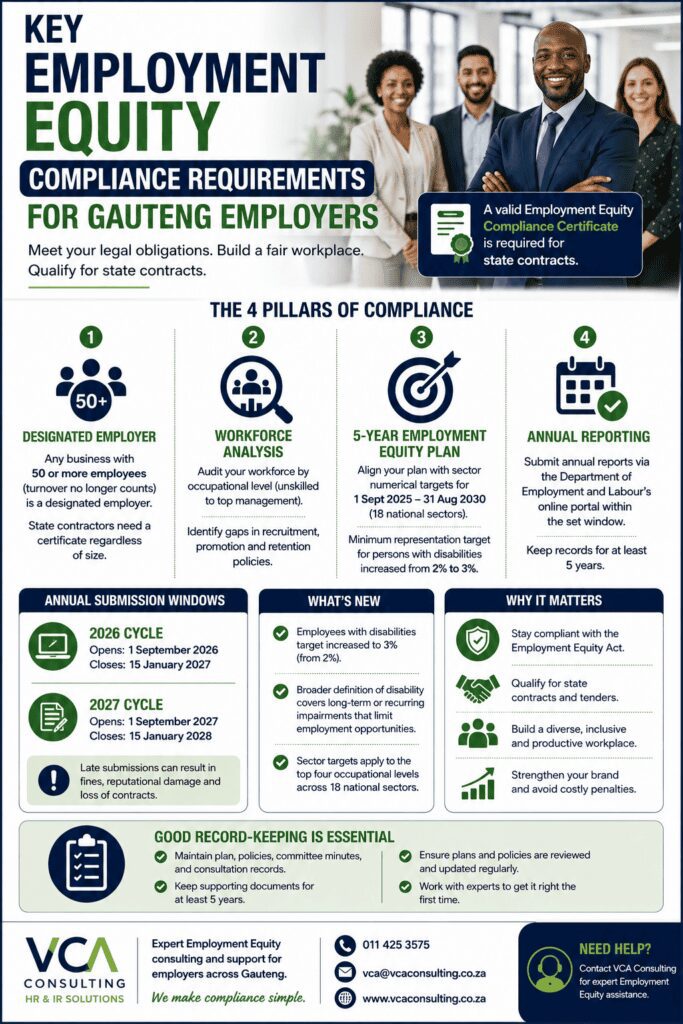
Key Employment Equity compliance requirements in South Africa rest on four pillars: headcount-based designation, a documented workforce analysis, a five-year Employment Equity Plan matched to sector numerical targets, and annual reporting through the Department of Employment and Labour’s online system. Any business with 50 or more employees on its books, and any business bidding for a state contract regardless of size, falls under these employment equity compliance requirements and must hold a valid compliance certificate before signing that contract. VCA Consulting guides employers through each stage of the process so that plans, targets, and submission dates are handled correctly the first time.
Employment Equity Compliance
Four Employment Equity Compliance Requirements Stand Between Your Business and a Valid EE Certificate
Fifty or more employees means consultation, workforce analysis, a five-year equity plan, and annual reporting are all mandatory. VCA Consulting handles every stage for East Rand employers, from the first headcount check to the final online submission.
Contact VCA Consulting for EE Assistance
Ask for Denise, she handles Employment Equity compliance enquiries directly.
EE Compliance Checklist
The four obligations every designated employer must meet
- Consultation with staff and trade unions
- Full workforce analysis by occupational level
- Five-year equity plan with sector targets
- Annual reporting to the Department
Key Takeaways
- The 50-employee headcount threshold alone now determines designated employer status; turnover no longer plays a role.
- Sector numerical targets cover 18 national economic sectors over the five-year period from 1 September 2025 to 31 August 2030.
- The minimum representation target for employees with disabilities has risen from 2% to 3%.
- Annual reports are submitted through the Department of Employment and Labour’s online portal within a fixed window each year.
- State contractors must hold a current compliance certificate before a contract can be awarded.
Who Must Meet Employment Equity Compliance Requirements
The starting point for any of these employment equity compliance requirements is a simple headcount. Once a business carries 50 or more employees, it becomes a designated employer under the employment equity framework, and turnover is no longer part of that calculation. A smaller Sandton startup with 80 staff on the books meets the threshold just as readily as a large Midrand manufacturer.
State contractors sit outside the headcount rule entirely. Any business tendering for government work in Gauteng province needs a valid Employment Equity compliance certificate regardless of staff numbers, because the Department will not issue that certificate without proof of compliance with sectoral numerical targets and up to date annual reporting. Firms based near the Sandton CBD or further out along the N1 corridor toward Midrand often discover this requirement only once a tender closes, which leaves little room to fix gaps before submission.
Getting the classification right at the outset avoids two common problems: businesses that wrongly assume they fall outside these employment equity compliance requirements because of old turnover-based rules, and businesses that only realise they need a compliance certificate after a tender deadline has already passed. VCA Consulting’s employment equity consulting services start with a designation check, confirming exactly where a business stands before any plan gets drafted.
Workforce Analysis: The First Practical Step
A workforce analysis is the first of the practical employment equity compliance requirements a designated employer must satisfy, and it sits underneath every later decision in the plan. The analysis audits recruitment, promotion, and retention policies against the actual demographic profile of the workforce, broken down by occupational level, from unskilled roles through to top management.
This is where generic templates fall short. A retail group operating across Gauteng needs a different occupational breakdown to a logistics firm running warehouses along the East Rand, and the analysis has to reflect that difference honestly rather than force every business into the same four-level spreadsheet. Employers frequently find that policies written years ago no longer match how promotions or recruitment happen day to day, and that gap has to be documented before a plan can address it.
VCA Consulting’s HR and IR services include this analysis as a standalone engagement or as the opening phase of a full Employment Equity Plan. Getting the audit right early keeps the rest of the employment equity compliance requirements grounded in real numbers rather than assumptions carried over from a previous plan.
Building a Five-Year Plan Around Sector Targets
Once the workforce analysis is complete, the next of the employment equity compliance requirements is a five-year Employment Equity Plan. Since April 2025, that plan has had to align with numerical targets set for 18 national economic sectors, covering the period from 1 September 2025 through to 31 August 2030. Targets apply across the top four occupational levels, and progress toward them, alongside current economically active population data, shapes each annual goal a designated employer sets.
One change worth flagging directly: the minimum representation target for employees with disabilities has moved from 2% to 3% across every sector, and the definition of disability itself has been broadened to cover long-term or recurring impairments that limit entry into or advancement within employment. A plan drafted before this change needs revisiting, not filing away as still current.
Consultation with employees and recognised trade unions runs alongside plan drafting rather than after it. Skipping meaningful engagement, or treating it as a formality, is one of the more common employer pitfalls that ends up costing businesses at the CCMA once a dispute over the plan surfaces. VCA Consulting’s guidance on employer pitfalls that cost you at the CCMA covers this specific failure point in more depth.
Annual Reporting and the Submission Window
Meeting the Employment Equity reporting requirements means submitting annual updates through the Department of Employment and Labour’s online portal within a defined window each year. The 2025 reporting cycle ran from 1 September 2025 to 15 January 2026, and that window has now closed. The 2026 cycle opens on 1 September and carries extra weight, since it marks the first year in which a designated employer’s actual progress gets measured directly against the five-year sector targets rather than against a self-set baseline.
Missing that window, or submitting a report that does not reconcile with the workforce analysis and plan already on file, exposes a business to compliance certificate refusal and closer scrutiny in future cycles. VCA Consulting’s breakdown of the 2026 submission deadline sets out exactly what needs to be ready before the portal opens.
Employment Equity and B-BBEE: Where the Two Overlap
Employment equity compliance requirements and B-BBEE scorecards are not the same obligation, though employers in Gauteng often confuse the two. B-BBEE measures broad-based transformation across ownership, management control, skills development, and enterprise development, while employment equity focuses specifically on workforce representation and reporting under its own Act. A business can score well on one and still fall short on the other.
Recent amendments affecting Enterprise and Supplier Development scorecards make this overlap more visible, since accurate workforce data now feeds both processes. VCA Consulting’s note on how the 2026 BEE amendments affect your ESD scorecard explains where the two frameworks intersect and where employers still need to treat them as separate exercises.
How VCA Consulting Solves Employment Equity Compliance Problems
Employers based anywhere from the Nelson Mandela Bridge precinct in central Johannesburg to the office parks around Sandton run into the same handful of problems when handling employment equity compliance requirements without dedicated support:
| Problem | How VCA Consulting Helps |
|---|---|
| No documented workforce analysis | Conducts the audit and builds the baseline data the plan needs |
| Plan not aligned to 2025 sector targets | Rebuilds the plan around the correct sectoral numerical targets |
| Consultation skipped or poorly recorded | Facilitates and documents engagement with staff and unions |
| Missed or incomplete annual reporting | Manages portal submissions ahead of the 1 September window |
| Disciplinary disputes linked to equity decisions | Provides independent disciplinary hearing chairperson services |
| Disability representation below the 3% target | Reviews recruitment pipelines and reasonable accommodation policy |
| BEE scorecard and EE data out of sync | Aligns B-BBEE consulting output with EE reporting figures |
Beyond the plan itself, VCA Consulting supports Gauteng businesses through Skills Development Facilitation, Payroll Services, Health & Safety Services, and Learnerships & Skills Programmes, all of which feed into the same workforce data an Employment Equity Plan depends on. Employers near Constitution Hill and the wider Johannesburg CBD, along with those further out toward Pretoria, rely on VCA Consulting’s HR services in Johannesburg to keep every one of these workstreams moving together rather than as separate, disconnected projects.
Pre-2025 vs Current Employment Equity Compliance Requirements
| Requirement | Before January 2025 | Current Position |
|---|---|---|
| Designated employer test | Headcount or turnover | Headcount only, 50+ employees |
| Sector targets | Not mandated | 18 sectors, numerical targets running to 2030 |
| Disability representation target | 2% | 3% |
| Governing regulations | Employment Equity Regulations, 2014 | Employment Equity Regulations, 2025 |
| Compliance certificate basis | General compliance | Certificate tied to sector target progress |
Frequently Asked Questions
What are the main employment equity compliance requirements for a business with 50 employees?
A business at this headcount must register as a designated employer, complete a workforce analysis, draft a five-year Employment Equity Plan aligned to its sector’s numerical targets, and submit annual reports through the online portal. VCA Consulting handles each stage as a single, coordinated process.
Do employment equity compliance requirements apply to small businesses bidding for government contracts?
Yes. Any business bidding for a state contract needs a valid Employment Equity compliance certificate regardless of its headcount, since the certificate is a precondition for the tender itself.
When does the next annual employment equity reporting window open?
The next submission window opens on 1 September 2026, and this cycle marks the first formal assessment of progress against the five-year sector targets set in April 2025.