
Skills development packages for businesses in the East Rand give SDL-registered employers a structured way to recover mandatory grants through accurate WSP and ATR submissions to their relevant SETA. Without a correctly compiled and submitted Workplace Skills Plan, companies forfeit the grants they have already funded through monthly SDL contributions to SARS. VCA Consulting manages this entire process end-to-end, from initial data gathering through to SETA-compliant uploads.
Key Takeaways
- SDL-registered employers must submit a WSP and ATR annually to qualify for mandatory grant recovery
- Common submission errors include unreconciled ATR figures, incorrect PIVOTAL classification, and incomplete training records
- A rejected submission means a forfeited grant with no second chance after the deadline
- Skills development packages from VCA Consulting start from R491 per month over 12 months
- East Rand businesses face the same SETA compliance obligations as any Gauteng employer
Why East Rand Businesses Lose Their Mandatory Grants Every Year
The Skills Development Act, 1998 created the legislative framework requiring qualifying employers to contribute 1% of their monthly payroll as a Skills Development Levy. The act also established the mechanism through which employers recover a portion of that levy via mandatory grants, provided their WSP and ATR submissions meet SETA requirements.
Most grant forfeitures are entirely preventable. They happen because:
- The WSP is incomplete or contains demographic errors
- ATR figures do not reconcile against actual training expenditure
- Training records do not match the spend reported
- PIVOTAL and non-PIVOTAL programmes are incorrectly classified
- Submissions are rejected by the SETA after the deadline has passed
Once the deadline closes, the grant is gone. There is no appeals process for late or rejected submissions.
What Skills Development Packages Include for East Rand Employers
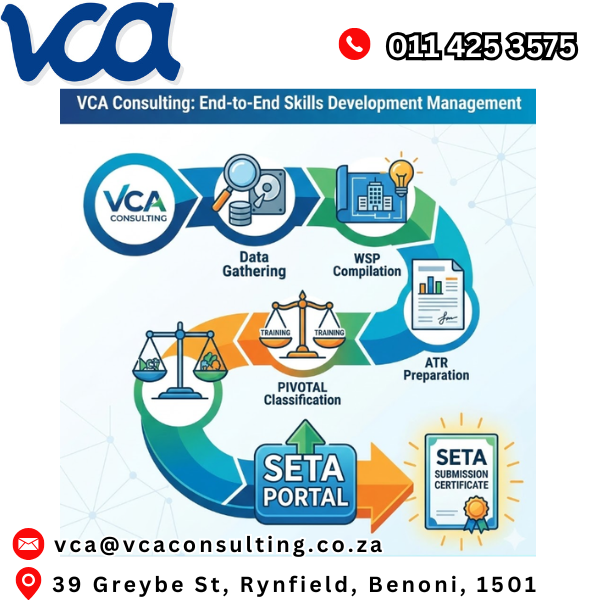
VCA Consulting’s skills development facilitation covers every component of the annual submission cycle. This is not a form-filling service. It is a compliance operation that reconciles payroll data, training records, and SETA requirements into a single, accurate submission.
The package covers:
| Component | What It Delivers |
|---|---|
| WSP Compilation | Complete Workplace Skills Plan aligned to SETA template |
| ATR Preparation | Annual Training Report with reconciled figures |
| PIVOTAL Classification | Correct categorisation of all training programmes |
| SETA Upload & Submission | Direct upload to the relevant SETA portal |
| Extension & Correction Support | Assistance if queries or rejections arise |
Businesses operating near the Boksburg CBD and along the Springs industrial corridor frequently manage complex multi-department training records. Getting the classification right across different occupational levels is where most DIY submissions fail.
The SDL Recovery Opportunity Businesses in the East Rand Miss
Every month, SDL-registered employers pay 1% of their leviable amount to SARS as part of their payroll services obligations. A portion of that levy is recoverable as a mandatory grant, provided the employer submits a compliant WSP and ATR before the annual deadline.
The East Rand is home to a dense concentration of manufacturing, logistics, and engineering businesses, many of which contribute SDL monthly without ever successfully recovering their grants. The reason is almost always submission quality, not eligibility.
Skills development packages for businesses in the East Rand are structured to close this gap by ensuring every submission is accurate, complete, and uploaded on time.
PIVOTAL Training and Why Classification Errors Cost Money
PIVOTAL programmes, which stands for Professional, Vocational, Technical and Academic Learning, attract a higher mandatory grant allocation than non-PIVOTAL training. Misclassifying a PIVOTAL programme as non-PIVOTAL leaves grant money unclaimed. Misclassifying non-PIVOTAL training as PIVOTAL triggers a rejection.
This distinction matters considerably for businesses in sectors with formal learnerships, internships, or apprenticeships. Skills development packages for businesses in the East Rand that include professional PIVOTAL classification protect employers from both of these outcomes.
VCA Consulting applies the correct classification to every training intervention on record, reconciles it against actual spend, and ensures the final submission reflects the maximum allowable grant recovery for that employer.
What Accurate Skills Development Reporting Does for B-BBEE
Skills development is one of the five elements scored under the B-BBEE scorecard. Accurate WSP and ATR submissions directly support a business’s skills development score, which affects its overall B-BBEE level. Businesses in the East Rand that fail to submit, or submit incorrectly, lose points they cannot recover retrospectively.
Skills development packages for businesses in the East Rand therefore carry compliance value well beyond grant recovery. They protect B-BBEE scoring, demonstrate regulatory credibility, and reduce the risk of SETA audits flagging inconsistencies in historical submissions.
Frequently Asked Questions
What is the annual deadline for WSP and ATR submissions to the SETA?
Most SETAs set their mandatory submission deadline for 30 April each year, though this can vary by sector. Submissions after the deadline are not accepted and the mandatory grant for that cycle is forfeited.
Which businesses in the East Rand are required to submit a WSP and ATR?
Any employer registered for SDL with SARS and contributing the monthly 1% levy qualifies and is obligated to submit a WSP and ATR annually to their relevant SETA to claim mandatory grants.
Can skills development packages for businesses in the East Rand assist with prior year corrections?
VCA Consulting provides correction and extension support where a SETA allows amendments, though the best outcome is always a first-submission that is accurate and complete before the deadline.