
Why EE Audits Matter: Employment Equity Compliance Every South African Employer Must Understand
An EE audit is a formal assessment of your business’s compliance with the Employment Equity Act, measuring both procedural obligations and substantive transformation progress. VCA Consulting works with designated employers across South Africa to ensure both dimensions of compliance are audit-ready. For any designated employer, understanding why EE audits matter is no longer optional, as the 2022 Employment Equity Amendment Act, fully operational from 1 January 2025, has fundamentally raised the compliance stakes.
Employment Equity Compliance
Is Your Business Ready for a DoEL EE Audit?
The Employment Equity Amendment Act is fully operational. Sector-specific targets, mandatory compliance certificates, and fines reaching 10% of annual turnover mean the cost of unpreparedness has never been higher.
EE Compliance Certificates are now required to do business with any organ of state
VCA Consulting covers every audit requirement
- EE Committee appointment and facilitation
- Workforce analysis (EEA12) and planning (EEA13)
- EEA2 and EEA4 preparation and submission
- Sector target alignment (2025 to 2030 cycle)
- Barrier identification and remedial action plans
- EE Compliance Certificate application support
- B-BBEE management control integration
- Skills development documentation for audit readiness
VCA Consulting — National HR & Compliance Specialists Since 1996
Key Takeaways
- Designated employers (50 or more employees) must submit annual EEA2 and EEA4 forms between 1 September and 15 January
- Non-compliance penalties reach up to R2.7 million or 10% of annual turnover, whichever is greater
- From 1 September 2025, all EE reports must align with new sector-specific five-year numerical targets
- An EE Compliance Certificate is now mandatory for employers doing business with the State
- Procedural compliance alone is insufficient; inspectors assess measurable transformation progress
What an EE Audit Actually Examines
The Department of Employment and Labour (DoEL) does not simply verify that you have submitted forms. A DoEL EE audit examines two distinct pillars that must both withstand scrutiny.
Procedural compliance covers the administrative and consultative obligations: formal appointment of an EE Manager under Section 24, election and functioning of an EE Committee, properly documented consultation meetings with signed attendance registers, and correct submission of EEA2 and EEA4 forms within prescribed deadlines. Inspectors request hard and soft copies of all documentation, including proof that employees were informed of EE plans and that the CEO or Accounting Officer approved the submitted reports.
Substantive compliance goes further. It assesses whether your workforce is actually changing, specifically whether designated groups (African, Coloured, and Indian South African citizens, women, and persons with disabilities) are being recruited, promoted, and retained across occupational levels at rates that reflect your five-year sector targets. This distinction matters because businesses that maintain clean paperwork but demonstrate no measurable transformation remain exposed to enforcement action under South African labour law.
VCA Consulting’s employment equity consulting services address both dimensions, with barrier audits that identify systemic gaps well before an official inspection.
The Penalties Employers Consistently Underestimate
Most businesses focus on the headline fine, which already reaches up to R2.7 million or 10% of annual turnover. The more immediate operational risk, introduced by the Employment Equity Amendment Act of 2022, affects revenue directly.
From 1 September 2025, any designated employer making an offer to do business with an organ of state must attach either an EE Compliance Certificate or a signed declaration of compliance. According to the Department of Employment and Labour, this certificate is valid for 12 months and requires employers to demonstrate timely EEA2 and EEA4 submissions, measurable progress toward sector targets, no CCMA unfair discrimination awards in the preceding 12 months, and compliance with the National Minimum Wage Act. A failure to comply is sufficient grounds for rejection of a state contract offer or cancellation of an existing agreement.
Beyond the financial consequences, the DoEL retains the authority to publicly name non-compliant employers. For businesses in Johannesburg competing for government contracts, tender awards, and corporate supplier agreements, this reputational exposure carries commercial weight that extends well past any single fine.
VCA Consulting has processed over 400 employment equity reports across diverse industries and understands precisely which data points trigger Department queries during their review process.
Procedural vs Substantive Compliance: A Quick Comparison
| Compliance Type | What It Covers | Primary Risk If Neglected |
|---|---|---|
| Procedural | Meetings, appointments, record-keeping, submissions | Compliance notices, immediate fines |
| Substantive | Actual workforce transformation progress | Loss of EE Certificate, state contract exclusion |
| Sector Targets | Progress against five-year numerical benchmarks (2025–2030) | Non-issuance of EE Certificate, enforcement action |
| Income Differential | EEA4 income gap reporting | Submission rejection, audit scrutiny |
The EE Audit Preparation Checklist
Getting audit-ready requires organising documentation that spans the full compliance cycle. Every document below must be available in both hard and soft copy when a DoEL inspector arrives.
Formal appointments: Written letters appointing your EE Manager under Section 24, and the formal appointment of your elected EE Committee members.
Consultation records: Agendas, signed attendance registers, and minutes from every EE committee meeting. Inspectors verify that consultation was substantive, not ceremonial.
Workforce analysis and plan: Completed EEA12 (workforce analysis) and EEA13 (five-year Employment Equity Plan). From 1 September 2025, plans must align with the newly gazetted sector-specific numerical targets for your industry across the 2025 to 2030 cycle.
Annual submission proof: Copies of submitted EEA2 and EEA4 forms, proof of employee notification, and CEO or Accounting Officer approval. Online submissions must be lodged by 15 January; manual submissions by 1 October.
Barrier identification records: Documentation of employment policies and practices that create or perpetuate inequity, with corresponding remedial action plans and timeframes.
VCA Consulting’s professional audits include competency, compliance, and EE-specific audits, providing organisations with an independent assessment before the DoEL arrives. This proactive approach consistently uncovers gaps that internal teams overlook.
How the EE Compliance Certificate Changes the Landscape
The EE Compliance Certificate, now operational under Section 53 of the amended EEA, represents the most significant structural change to employment equity enforcement in South Africa in decades. Employers apply via the EEA15 form through the DoEL’s online system. The certificate is issued automatically once the employer’s declared compliance is accepted, and it remains valid for 12 months.
The certificate can be withdrawn if it was issued on the basis of misrepresentation or fraudulent information. Providing false information to obtain a certificate constitutes a criminal offence. Before withdrawal, the employer receives 14 days to make representations via an EEA16C notice, and once withdrawn, the consequences for state contracting are immediate.
For employers that have integrated their Employment Equity obligations with their B-BBEE consulting strategy, the certificate also feeds into management control scoring. Non-compliance affects the scorecard directly, meaning EE shortfalls carry a multiplied commercial consequence.
What Inspectors Find Most Frequently
DoEL inspectors across Gauteng consistently encounter the same categories of failure. Understanding these patterns is more useful than a generic compliance checklist.
Inadequate consultation records remain the most common finding. Businesses maintain an EE committee on paper but cannot produce minutes, attendance registers, or evidence that committee input shaped the equity plan. The DoEL requires genuine consultation, not a rubber-stamp process.
Demographic data errors create submission rejections. Foreign nationals do not qualify as designated group members regardless of their demographic profile, as only South African citizens are counted. Incorrect classification of employees at occupational levels generates mismatches between EEA12 analysis and EEA13 targets that inspectors identify immediately.
Misalignment between the EE Plan and annual submissions is another trigger. The EEA2 must align precisely with the employer’s five-year plan. Inspectors who audit submissions can request the full equity plan and will scrutinise contradictions between the two documents.
Businesses working with VCA Consulting’s HR and IR services benefit from integrated record-keeping that eliminates these misalignments before they become compliance liabilities.
Skills Development as an EE Audit Factor
Training is not a soft obligation under the Employment Equity Act. Inspectors assess whether employers are investing in skills development for designated groups as part of their barrier removal plans. The EEA13 must document specific training interventions, the demographic profile of recipients, programme duration, and measurable outcomes.
Employers enrolled in structured Learnerships and Skills Programmes aligned to their sector’s SETA framework create a direct link between equity plan training commitments and verifiable SETA records. This dual documentation significantly strengthens audit readiness, particularly for employers under sector targets that require accelerated representation of designated groups at professional and middle management levels.
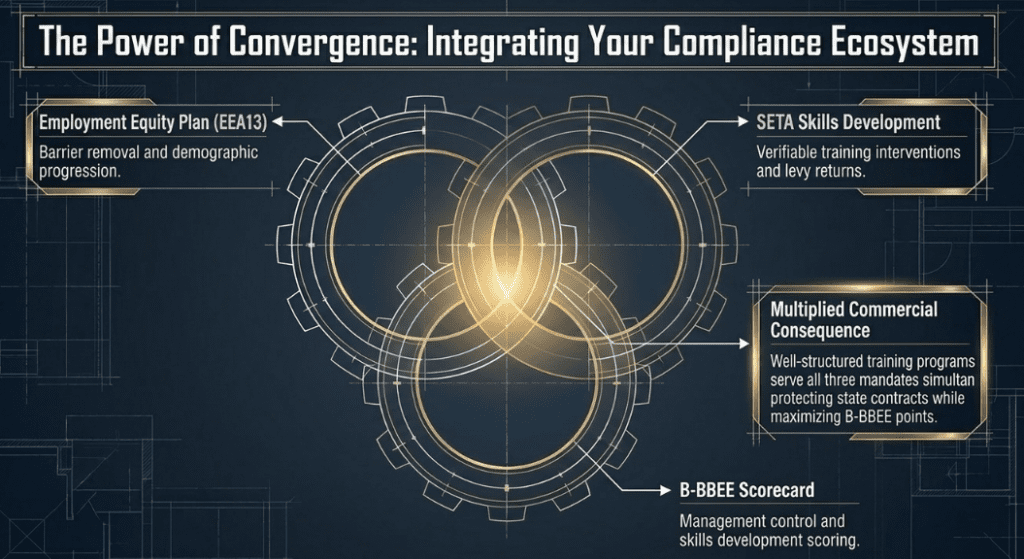
Skills Development Facilitation tied to an EE plan also contributes to B-BBEE scorecard performance, meaning well-structured training programmes serve three compliance requirements simultaneously: EE plan obligations, SETA levy returns, and B-BBEE skills development scoring.
Frequently Asked Questions
What is an EE audit?
An EE audit is a formal assessment conducted by a DoEL labour inspector or an independent compliance specialist to verify that a designated employer is meeting both procedural obligations (consultation, record-keeping, submissions) and substantive requirements (measurable transformation progress) under the Employment Equity Act. VCA Consulting’s professional audits cover EE compliance alongside skills, competency, and vendor audits.
Who must submit EE reports?
Any designated employer, defined as an organisation employing 50 or more employees, is required to submit complete annual EEA2 and EEA4 reports. The 2022 amendments removed turnover thresholds, so the 50-employee criterion now applies universally. Organs of state and municipalities are designated regardless of employee numbers.
What are EE requirements?
Designated employers must conduct a workforce analysis using the EEA12 form, develop and implement a five-year Employment Equity Plan (EEA13) aligned to their sector’s numerical targets, consult with employees through an elected EE Committee, submit annual EEA2 and EEA4 reports within prescribed deadlines, and maintain comprehensive records of all the above processes.
What are the 4 types of audit?
VCA Consulting assists businesses with four primary audit types: skills audits (identifying training needs and competency gaps), compliance audits (assessing adherence to legislation including the Employment Equity Act and Occupational Health and Safety Act), EE audits (specific employment equity compliance verification), and vendor audits (ensuring that contracted suppliers follow agreed processes and procedures).
What is an EE compliance certificate?
An EE Compliance Certificate is an official document issued by the Minister of Employment and Labour confirming that an employer has met EE requirements for the preceding reporting period. Under Section 53 of the amended Employment Equity Act, this certificate is now mandatory for employers wishing to do business with any organ of state. It is valid for 12 months, applied for via the EEA15 form, and can be withdrawn if issued on the basis of inaccurate or fraudulent information.