4 Essential Requirements for Employment Equity Compliance
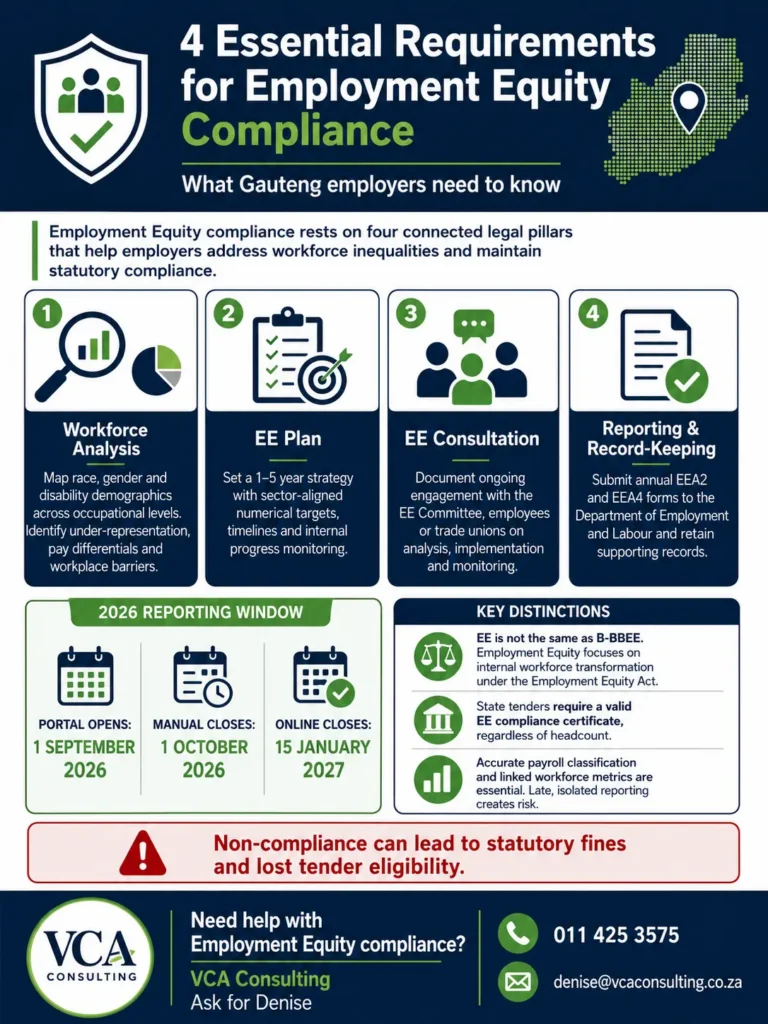
Employment equity compliance rests on four pillars that every designated employer in South Africa must satisfy: a properly developed Employment Equity Plan, a completed workforce analysis, meaningful consultation with employees, and accurate reporting to the Department of Employment and Labour. VCA Consulting, an outsourced Human Resources consultancy operating since 1996, works with designated employers across Gauteng to build these four elements into a single, defensible compliance framework rather than a last-minute scramble before the reporting window closes.
Table of Contents
- Who Counts as a Designated Employer
- Requirement 1: The Employment Equity Plan
- Requirement 2: Workforce Analysis
- Requirement 3: Employment Equity Consultation
- Requirement 4: EE Reporting and Record-Keeping
- How the Four Requirements Fit Together
- Why Employers Bring In Specialist Support
- Frequently Asked Questions
Key Takeaways
| Requirement | What It Involves |
|---|---|
| Employment Equity Plan | A 5-year plan setting objectives, numerical goals and targets to address workforce inequalities |
| Workforce Analysis | Identifying under-representation and barriers across occupational levels and designated groups |
| Employment Equity Consultation | Structured engagement with employees or an EE Committee on the analysis, plan and monitoring process |
| EE Reporting & Record-Keeping | Maintaining accurate records and submitting EEA2 and EEA4 forms within the prescribed reporting period |
Who Counts as a Designated Employer
Employment equity compliance applies to designated employers: businesses with 50 or more employees, employers below that threshold with an annual turnover above the threshold set for their sector, municipalities, and organs of state. Once a business crosses that line, all four employment equity compliance requirements become a legal obligation rather than a voluntary exercise. VCA Consulting’s employment equity consulting service typically begins with confirming designated status, since employers who register late or misjudge their headcount threshold often find themselves behind schedule before the plan and workforce analysis have even started.
The obligation does not disappear for smaller businesses either. Employers under the headcount threshold still fall under the unfair discrimination provisions of the Employment Equity Act, even though the plan, analysis and reporting requirements apply specifically to designated employers.
Requirement 1: The Employment Equity Plan
The first of the four employment equity compliance requirements is a written Employment Equity Plan covering a period of one to five years, most commonly set at five years to align with the Department’s sector-specific numerical targets. This plan sets out the objectives an employer intends to achieve, the numerical goals and targets for each occupational level, the timetable for reaching them, and the internal procedures for monitoring progress.
A plan built purely to satisfy a checklist rarely survives scrutiny. The Department increasingly expects targets that reconcile with the employer’s actual workforce analysis and reflect genuine progress, not aspirational numbers copied from a template. Businesses working through the key employment equity compliance requirements affecting their sector will recognise how closely this plan needs to track sectoral targets set for each industry.
Comparison: Employment Equity Plan vs B-BBEE Scorecard
| Feature | Employment Equity Plan | B-BBEE Scorecard |
|---|---|---|
| Legislative basis | Employment Equity Act | B-BBEE Codes of Good Practice |
| Focus | Workforce representation by occupational level | Ownership, management control, skills development, enterprise development |
| Reporting body | Department of Employment and Labour | B-BBEE Verification Agency |
| Time horizon | Up to 5 years | Annual scorecard cycle |
| Penalty for non-compliance | Fines, compliance certificate refusal | Reduced B-BBEE level, lost tender eligibility |
VCA Consulting’s B-BBEE consulting team frequently fields questions from employers who assume a strong B-BBEE score automatically covers their employment equity compliance requirements. It does not. The two frameworks measure different things, and a business can score well on one while falling short on the other.
Requirement 2: Workforce Analysis
The second requirement is a workforce analysis: a structured review of the employer’s staff profile across every occupational level, broken down by race, gender and disability status, to identify under-representation, barriers to advancement and existing inequalities. This analysis forms the evidence base for the Employment Equity Plan; without it, numerical goals have nothing concrete to anchor them.
- Occupational level mapping identifies where designated groups are concentrated or absent, typically comparing top management, senior management, professionals, skilled technical staff and semi-skilled roles against national or regional economically active population data.
- Barrier identification looks beyond headcount to recruitment practices, promotion patterns, retention rates and remuneration differentials that may be limiting progress for designated groups.
- Data granularity is where most employers struggle, since HR systems built for payroll processing rarely capture the demographic detail the Department expects during a review.
Employers who have gone through an Employment Equity Director-General Review know how closely inspectors examine whether the workforce analysis genuinely supports the numerical targets in the plan, rather than simply restating them.
Requirement 3: Employment Equity Consultation
The third employment equity compliance requirement is consultation. Designated employers must consult with a representative trade union, or with employees directly (or through an Employment Equity Committee), on the workforce analysis, the plan itself, its implementation, and the ongoing monitoring of progress. This is not a single meeting held once a year before the report goes in.
Effective consultation is documented, recurring and specific: minutes recording what was discussed, what objections or suggestions were raised, and how management responded. Where an EE Committee exists, its composition should reflect the designated groups it represents, and its mandate should extend across the full compliance cycle rather than a single sign-off before submission. VCA Consulting’s HR and IR services support employers in setting up and running these consultative structures so that consultation records hold up if the Department ever queries the process behind a submitted plan.
Requirement 4: EE Reporting and Record-Keeping
The fourth requirement covers reporting and record-keeping: designated employers must maintain accurate employment equity records throughout the year and submit the prescribed components of EEA2 and EEA4 reports to the Department of Employment and Labour within the applicable window.
For the 2026 cycle, both submission methods open on 1 September 2026. Manual submissions close on 1 October 2026, while online submissions remain open until 15 January 2027 through the Department’s portal. Employers confused by earlier deadline dates circulating online should check the employment equity submission deadline 2026 guidance directly, since the reporting cycle shifted from the prior year and the 15 January 2026 date applied to the previous cycle, not the current one.
- Confirm designated employer status and registration on the Department’s online portal well before the window opens.
- Reconcile the EEA2 report against the workforce analysis and plan already on file, since mismatches trigger closer Departmental scrutiny.
- Prepare EEA4 income differential data alongside the EEA2, since both forms are typically due together.
- Retain consultation records, minutes and correspondence as supporting evidence, not just the final submitted forms.
Employers tendering for government contracts in Gauteng face an added dimension here. State contractors need a valid Employment Equity compliance certificate regardless of headcount, and the Department will not issue one without proof of compliance with sectoral numerical targets and up-to-date reporting.
How the Four Requirements Fit Together
Employment equity compliance requirements do not function as four separate boxes to tick in isolation. The workforce analysis feeds the plan’s numerical targets. Consultation shapes and validates both the analysis and the plan before anything is finalised. Reporting then documents the outcome of that entire process for the Department’s review. Skipping straight to the report without the analysis and consultation behind it is the most common reason submissions get flagged during a review.
VCA Consulting’s payroll services integrate with this cycle by ensuring employee classification data used for payroll matches the categories required for EE reporting, since discrepancies between the two are a frequent source of queries. Employers weighing up HR consulting vs HR outsourcing for their compliance function often find that an outsourced specialist keeps these four workstreams moving in parallel rather than compressed into the final weeks before a deadline.
Why Employers Bring In Specialist Support
Handling employment equity compliance requirements internally is possible for larger organisations with a dedicated HR function, but most designated employers in Gauteng operate without one. The HR function typically lands on a business owner, operations manager or financial director already carrying a full workload, and employment equity compliance is rarely their area of specialist knowledge.
- Sector-specific targets: numerical goals now align with targets published for each sector, and getting this wrong in the plan creates a mismatch the Department will query.
- Documentation standards: reports that link identified barriers to specific remedial actions with named accountability and timelines meet a materially higher standard than generic statements of intent.
- Ongoing monitoring: compliance is not a once-a-year event, and businesses without a system for tracking progress between reporting cycles often arrive at the deadline with incomplete evidence.
Businesses reviewing what HR services in Johannesburg typically cover will find employment equity planning listed alongside skills development facilitation, health and safety services, and learnerships and skills programmes as part of a single outsourced HR function, rather than a standalone compliance task handled separately.
Frequently Asked Questions
What happens if a designated employer misses the employment equity submission deadline?
Late submissions can result in fines that scale with company size, refusal of a Certificate of Compliance, and closer scrutiny during future reporting cycles. The certificate matters beyond the immediate penalty, since many public sector tenders in Gauteng require a valid one regardless of how strong the underlying transformation plan is.
Do businesses with fewer than 50 employees need an Employment Equity Plan?
Businesses below the 50-employee threshold are generally not designated employers under the Employment Equity Act and are not required to submit a plan or report, unless their annual turnover exceeds the threshold set for their sector. They remain subject to the Act’s unfair discrimination provisions regardless of size.
How does VCA Consulting help with employment equity compliance?
VCA Consulting provides end-to-end employment equity consulting, covering workforce analysis, plan development, consultative committee facilitation, EEA2 and EEA4 preparation, and submission management, drawing on experience gained from processing several hundred employment equity reports across different industries.
Is an Employment Equity Plan the same thing as a B-BBEE scorecard?
No. The Employment Equity Plan is a legal requirement under the Employment Equity Act focused on workforce representation, while the B-BBEE scorecard measures broader transformation across ownership, management control, skills development and enterprise development. A business can comply with one and still fall short of the other.
When does the 2026 employment equity reporting cycle open and close?
Both manual and online submission windows open on 1 September 2026. Manual submissions close on 1 October 2026, and online submissions remain open until 15 January 2027 through the Department of Employment and Labour’s portal.
For assistance with any of the four employment equity compliance requirements, from workforce analysis through to EEA2 and EEA4 submission, contact Denise and the team at VCA Consulting on 011 425 3575 or vca@vcaconsulting.co.za.