
4 Essential Requirements for Employment Equity Reports in Gauteng
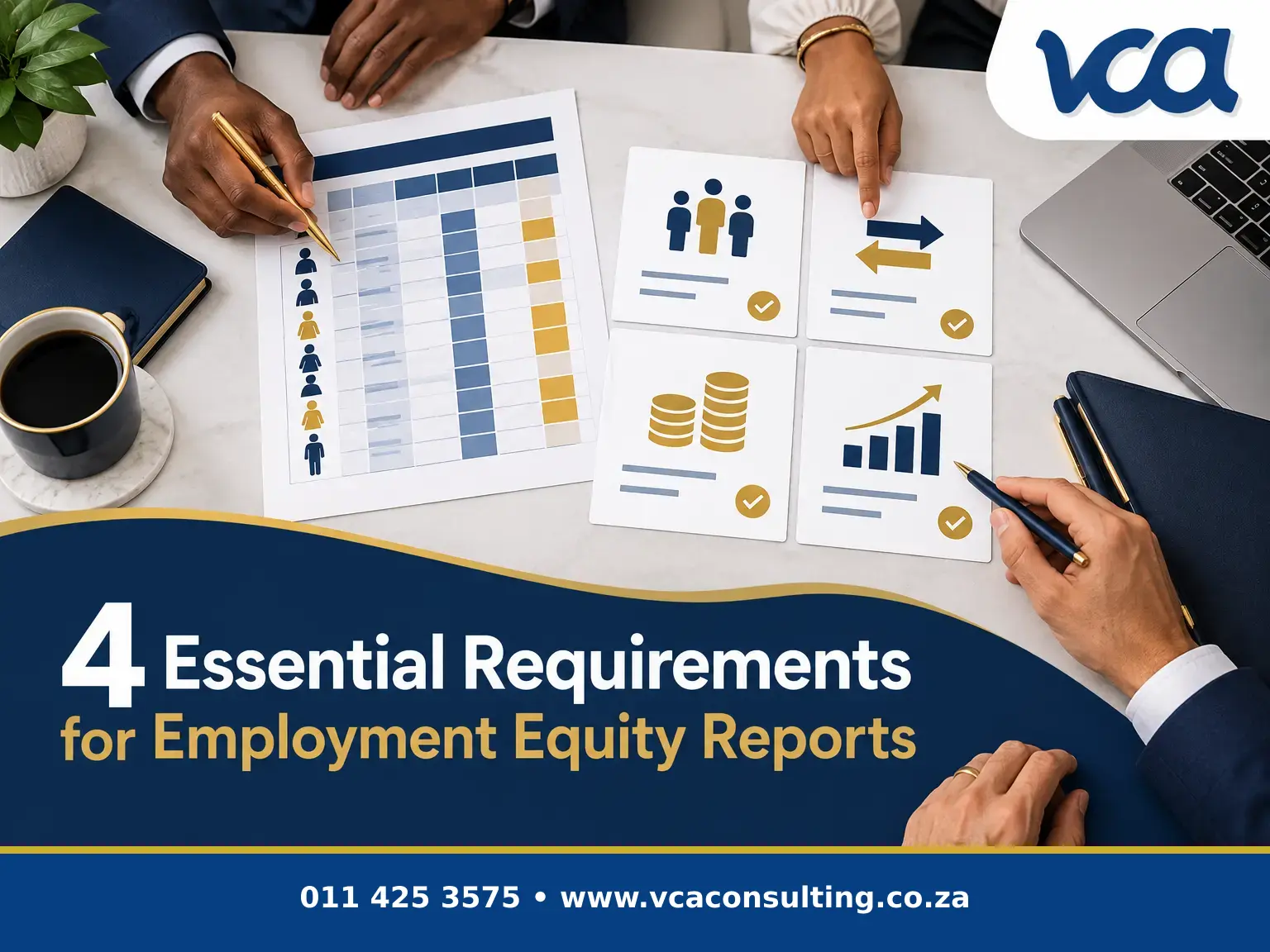
4 Essential Requirements for Employment Equity Reports are an accurate workforce profile, complete employee movement data, correctly classified remuneration information, and measured progress against the Employment Equity Plan. VCA Consulting helps designated employers across Gauteng prepare EEA2 and EEA4 submissions, reconcile supporting records and correct gaps before filing.

Key Takeaways
The 4 Essential Requirements for Employment Equity Reports connect source records to the prescribed reporting fields and the employer's approved EE Plan.
| Operational requirement | What the report must show |
|---|---|
| Workforce profile | A verified snapshot at 31 August 2026 by occupational level, race, gender, foreign-national status and disability status. |
| Employee movements | Recruitments, promotions and terminations during the reporting period, classified consistently. |
| Remuneration | Income differentials and remuneration data aligned to the correct occupational levels and demographic groups. |
| Goals and progress | Annual targets, results, monitoring frequency and clear reasons for objectives that were not achieved. |

How to Prepare the 4 Essential Requirements for Employment Equity Reports
Preparation should begin before data capture. The reporting team must confirm the designated employer's registration details, reporting structure, CEO and assigned EE manager. It should then lock the reporting dataset and reconcile employee identifiers across HR and payroll. VCA Consulting's Employment Equity consulting service supports this work from data validation through submission.
The 4 Essential Requirements for Employment Equity Reports should draw from one controlled source file. A sound process assigns each job to an occupational level based on responsibility and decision-making authority, rather than job title alone.
- Reporting control: Freeze the 31 August snapshot, retain a dated copy and record all later changes outside the submission dataset.
- Local application: Gauteng employers operating near OR Tambo International Airport, Sandton City, Constitution Hill or the Union Buildings still apply the same national forms, although workforce patterns differ by site and sector.
Requirement 1: Accurate Workforce Profile for the 4 Essential Requirements for Employment Equity Reports
The workforce profile records every employee in the correct occupational level as at 31 August 2026. It distinguishes race and gender groups, foreign nationals, permanent and temporary employees, and employees with disabilities. The data should agree with payroll headcount, active employment contracts and the employer's HR register.
For the 4 Essential Requirements for Employment Equity Reports, demographic information should come from confidential employee declarations and authorised records. VCA Consulting can test the profile against the employer's workforce analysis and the key Employment Equity compliance requirements.
Workforce profile checks
- Reconcile totals: Confirm that permanent staff, temporary staff and the grand total agree across every table. Investigate employees on unpaid leave, fixed-term contracts, transfers and recent starters before capture.
- Classify jobs consistently: Use job content and accountability to assign occupational levels. The same grading logic must flow into workforce, movement and remuneration tables.
Requirement 2: Employment Movements in the 4 Essential Requirements for Employment Equity Reports
Employment movements explain how the workforce changed during the reporting period. Recruitment, promotion and termination totals must reflect the correct demographic group and occupational level.
The 4 Essential Requirements for Employment Equity Reports depend on movement data that can be traced back to appointment letters, promotion approvals, termination records and payroll effective dates. Employers that combine HR administration with external support should confirm where accountability sits. The distinction between HR consulting and HR outsourcing helps management assign capture, review and sign-off duties.
Movement reconciliation controls
- Use effective dates: Report the date on which an appointment, promotion or termination took effect, then compare the event register with payroll changes for the same period.
- Avoid double counting: Record each event once in its correct category. Keep an audit trail where an employee had several legitimate movements.
Requirement 3: Remuneration Data for the 4 Essential Requirements for Employment Equity Reports
Remuneration information is reported through the EEA4 and should align with the same occupational levels and demographic categories used in the workforce data. Employers need a documented basis for the remuneration figures, including the reporting period, the treatment of variable pay and the distinction between remuneration and benefits where the form requires it.
The 4 Essential Requirements for Employment Equity Reports require more than a payroll export. Payroll codes may group people by department or cost centre, while Employment Equity reporting groups them by occupational level and demographic category. The responsible team should map those structures, review material income differentials and retain explanations for legitimate factors such as seniority, qualifications, performance, scarce skills or length of service. This work sits within a broader human resources management control system.
EEA4 quality checks
- Match the profile: Employee totals and occupational-level assignments should reconcile with the relevant workforce records before remuneration values are aggregated.
- Protect confidentiality: Limit access to payroll data, aggregate information correctly and store working papers in a controlled compliance file.
Requirement 4: Numerical Goals and Progress in the 4 Essential Requirements for Employment Equity Reports
Employers must report annual numerical targets from the approved Employment Equity Plan and show progress against annual objectives. The figures should cover the entire workforce profile where required, not merely the projected difference between current representation and a target. Regulated sector targets and the employer's own numerical goals must remain distinguishable.
The 4 Essential Requirements for Employment Equity Reports require an honest account of performance. If an objective was missed, management should record a specific reason and corrective action. Employers can compare current preparation steps with VCA Consulting's Employment Equity submission guide for 2026 and confirm the 2026 Employment Equity submission deadline.
Progress reporting controls
- Trace each target: Link every reported target to the signed EE Plan, then compare results with workforce and movement data.
- Support explanations: Keep committee minutes, recruitment evidence, skills development records and approved corrective actions for objectives that were not achieved.
Validate the 4 Essential Requirements for Employment Equity Reports Before Submission
A final review should test totals, classifications and explanations across EEA2, EEA4, payroll, the workforce profile and the EE Plan. The CEO or accounting officer should receive a short exception report before authorisation. VCA Consulting also prepares employers for Employment Equity Director-General reviews, where supporting documents and implementation evidence may be assessed.
| Form | Primary content | Core source records |
|---|---|---|
| EEA2 | Workforce profile, movements, skills development, targets and progress | HR register, declarations, movement log, EE Plan and committee records |
| EEA4 | Income differentials and remuneration information | Payroll, grading records and documented reasons for differentials |
Businesses across Gauteng's major economic centres can apply the same validation sequence. VCA Consulting combines Employment Equity consulting with Skills Development Facilitation, HR & IR Services, Payroll Services, Health & Safety Services, Learnerships & Skills Programmes and B-BBEE Consulting. A wider view of the four essential requirements for Employment Equity compliance helps employers connect annual reporting with year-round implementation.
Frequently Asked Questions
What are the 4 Essential Requirements for Employment Equity Reports?
They are an accurate workforce profile, complete employment movement data, correct remuneration information, and documented numerical targets and progress. Each area should reconcile with HR, payroll and the approved Employment Equity Plan.
Which forms must a designated employer submit for 2026?
The Department of Employment and Labour's 2026 portal accepts EEA2 and EEA4 reports. Employers should keep the EEA12 analysis and EEA13 plan as supporting implementation records rather than submit them through the annual reporting portal.
What is the workforce profile date for the 2026 report?
The workforce profile should reflect the employer's employees as at 31 August 2026. The reporting team should freeze and retain that dated dataset so later hires or exits do not distort the snapshot.
What happens if numerical targets were not achieved?
The employer should report the result honestly, provide a specific reason and record corrective action. Supporting evidence may include recruitment outcomes, skills records, EE committee minutes and management decisions.
Can VCA Consulting complete an Employment Equity report on behalf of an employer?
Yes. VCA Consulting can assist with data preparation, occupational-level checks, EEA2 and EEA4 reconciliation, submission support and the compliance file. The employer's authorised leadership remains responsible for the accuracy and approval of the reported information.
