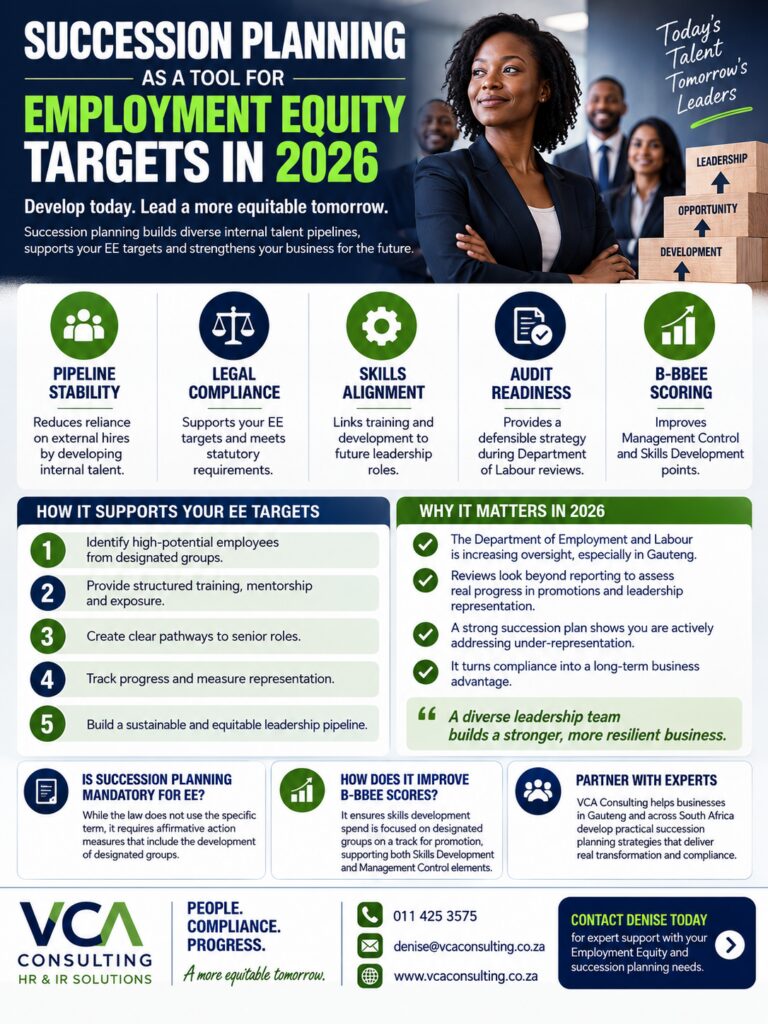
Succession Planning as a Tool for Employment Equity Targets in 2026
As we navigate the complexities of the 2026 business landscape, using succession planning as a tool for Employment Equity targets has become a strategic necessity for South African firms. It is concerning to note that despite global diversity initiatives, the number of women CEOs in the S&P 500 plateaued at just 48 across 2024 and 2025, emphasizing the urgent need for robust, equitable internal pipelines.
Key Takeaways
| Aspect | Impact on Equity Goals |
|---|---|
| Pipeline Stability | Reduces reliance on external hires by developing internal talent. |
| Legal Compliance | Meets the requirements for 4 essential requirements for Employment Equity compliance. |
| Skills Alignment | Connects training spend directly to future leadership roles. |
| Audit Readiness | Provides a defensible strategy during Department of Labour inspections. |
| B-BBEE Scoring | Improves Management Control and Skills Development points. |
Is succession planning mandatory for Employment Equity?
While the law does not use the specific term "succession planning," it requires affirmative action measures that include the development of designated groups. We use these plans to prove that the company is actively working to eliminate under-representation at senior levels.
How does succession planning improve B-BBEE scores?
It ensures that your skills development spend is focused on individuals from designated groups who are on a track for promotion. This satisfies both the Skills Development and Management Control elements of your scorecard.
Understanding Succession Planning as a Tool for Employment Equity Targets
We view succession planning as a proactive management strategy that identifies and develops internal talent to fill key leadership positions. When applied correctly, it serves as a primary mechanism for transforming the demographic profile of an organization at its most senior levels.
In the current 2026 reporting cycle, companies must demonstrate that their professional Employment Equity consulting efforts are producing tangible results. It is no longer enough to set numerical goals without a clear roadmap for how individuals will progress through the ranks.
Succession planning provides this roadmap by formalizing the journey from entry-level roles to executive management. By identifying high-potential employees from designated groups early in their careers, we can provide the specific exposure and mentorship they need to succeed.
This approach transforms transformation from a compliance checkbox into a sustainable business strategy. It ensures that when a vacancy arises at the top, the organization has a ready and representative pool of candidates to draw from.
Why Gauteng Employers Need Succession Planning as a Tool for Employment Equity Targets
Employers in Gauteng face a unique set of challenges and opportunities when it comes to workforce transformation. With the highest concentration of corporate headquarters in South Africa, the pressure to meet representation targets is intense, especially during Employment Equity Director-General reviews.
The Department of Employment and Labour has significantly increased its oversight of Gauteng-based businesses in 2026. These reviews now look beyond the surface of annual reports to determine if promotion and recruitment practices are genuinely equitable.
Without a formalized succession strategy, many firms struggle to explain why their senior management remains untransformed despite high levels of recruitment at lower levels. Succession planning provides the evidence needed to show that a company is actively addressing barriers to advancement.
We have found that companies utilizing structured succession models are far more likely to survive a DG Review without facing fines. These plans demonstrate that the organization is not just waiting for turnover to happen but is actively preparing for it with equity in mind.
Integrating Skills Development with Succession Planning as a Tool for Employment Equity Targets
The synergy between training and succession is the core of effective transformation. We must align our skills development facilitation with the specific competencies required for future leadership roles.
In 2026, the cost of training is high, and companies cannot afford to spend their levies on programs that do not support their long-term equity goals. By linking training to a succession plan, we ensure that every Rand spent contributes to building a representative leadership bench.
This integration requires a deep dive into the Workplace Skills Plan (WSP) and the Annual Training Report (ATR). We recommend that employers use their succession lists to prioritize candidates for high-level management development programs and executive coaching.
Effective Employment Equity plan training should also include sensitizing current managers to the importance of mentorship. When senior leaders understand their role in developing their successors from designated groups, the entire organizational culture shifts toward inclusivity.
Aon finds succession planning has become a core lever for meeting equity targets.
Compliance Benefits of Succession Planning as a Tool for Employment Equity Targets
The Department of Labour views a lack of internal promotion as a potential sign of unfair discrimination. By formalizing succession planning as a tool for Employment Equity targets, we create a transparent and objective process for advancement.
This transparency is vital for employee morale and retention. When workers from designated groups see a clear path to the top, they are more likely to remain with the company and invest in their own professional development.
From a documentation perspective, a succession plan acts as a primary affirmative action measure. It allows us to prove that we are addressing the "glass ceiling" effect that often keeps under-represented groups in junior or middle-management positions.
Furthermore, these plans help in managing the expectations of the Employment Equity Committee. When the committee can see a multi-year strategy for transformation, they are more likely to support the company’s long-term vision and reporting processes.
Using Professional Audits to Validate Your Strategy
To ensure that our efforts are effective, we must conduct regular professional audits of our HR processes. These audits verify that the succession plan is being implemented as intended and that it is actually moving the needle on representation.
An audit should examine the "drop-off rate" of candidates in the pipeline. If candidates from designated groups are entering the succession pool but are not actually being promoted, there may be hidden barriers or biases in the selection process.
We use this data to refine our strategies and provide targeted support where it is needed most. This might involve additional technical training, leadership coaching, or changes to the performance management system.
In 2026, data-driven decision-making is the gold standard for HR. By auditing our succession plans, we move away from anecdotal evidence and toward a robust, defensible compliance framework.
Implementing Succession Planning in Your HR and IR Strategy
Succession planning does not exist in a vacuum. It must be woven into the fabric of our HR and IR services to ensure that it aligns with labor laws and internal policies.
One critical area is the intersection of succession and industrial relations. We must ensure that the selection of successors is based on objective criteria to avoid grievances or claims of unfair labor practices.
Clear communication is essential during this process. Employees need to understand that while the succession plan identifies potential, it does not guarantee a promotion. This manages expectations and maintains a high-performance culture.
We also look at how disciplinary records and performance reviews impact the succession pipeline. A robust HR system ensures that these factors are considered fairly and consistently across all employee groups.
The Role of the Employment Equity Act in Shaping Plans
All our efforts must remain rooted in the Employment Equity Act. This legislation provides the framework for what is permissible and required when it comes to affirmative action.
The Act encourages the use of "reasonable steps" to ensure representation. We consider a well-documented succession plan to be one of the most reasonable and effective steps a designated employer can take in 2026.
It allows us to set realistic numerical targets based on the actual potential within our workforce. This prevents the setting of arbitrary goals that the organization cannot possibly achieve without resorting to non-compliant practices.
Furthermore, the Act requires consultation with the EE Committee on these matters. Presenting a succession plan to the committee is an excellent way to engage them in meaningful discussion about the company's future.
Overcoming Barriers to Equitable Succession
Even with the best intentions, succession planning can face hurdles. Common barriers include unconscious bias in candidate identification and a lack of commitment from middle management.
We address these issues through regular training and by making equity goals a part of every manager’s performance KPIs. When managers are held accountable for the diversity of their talent pipelines, the focus on succession planning increases significantly.
Another barrier is the "talent hoarding" phenomenon, where managers are reluctant to let their best people move into different roles. We counter this by rewarding managers who successfully develop and "export" talent to other parts of the business.
Finally, we must ensure that our succession planning is dynamic. In the fast-paced 2026 economy, the skills required for a role today might be different tomorrow. Our plans must be flexible enough to adapt to changing business needs while staying committed to equity targets.
Conclusion
Ultimately, succession planning as a tool for Employment Equity targets is about creating a future-proof organization. By investing in the development of our internal talent today, we ensure a diverse and capable leadership team for tomorrow.
This approach not only satisfies legal requirements but also drives business performance by reducing the risks associated with external hiring and high staff turnover. We remain committed to helping South African businesses navigate this journey with confidence and integrity.
As the 2026 reporting deadlines approach, now is the time to audit your talent pipeline. Ensuring your succession strategies are aligned with your equity goals is the most effective way to achieve sustainable transformation and long-term success.
Frequently Asked Questions
Is succession planning as a tool for Employment Equity targets worth it in 2026?
Yes, it is one of the most effective ways to ensure long-term compliance and build a representative leadership bench. By 2026, companies that rely solely on external recruitment struggle to meet their targets and face higher turnover costs.
How do I start a succession plan that meets Employment Equity requirements?
Begin with a comprehensive workforce analysis to identify gaps and then match high-potential employees from designated groups to future roles. Link this plan directly to your training initiatives to ensure candidates gain the necessary competencies for advancement.
Can we use AI to help with succession planning as a tool for Employment Equity targets?
AI can be a powerful tool for identifying talent and reducing human bias, provided the data used is clean and the algorithms are transparent. Many forward-thinking firms are using AI in 2026 to spot leadership potential that might have been overlooked by traditional methods.
Does a succession plan mean we cannot hire externally?
No, but it ensures that internal candidates from designated groups are given priority and are properly prepared for the role. A strong succession plan reduces the need for external searches, which are often more expensive and have a higher failure rate.
How often should we review our succession planning as a tool for Employment Equity targets?
We recommend a formal review at least once a year, ideally in alignment with your annual Employment Equity reporting and skills development submissions. Regular reviews allow you to adjust for changes in the business environment and the progress of your candidates.
What happens if our successors leave the company?
Succession planning should always include multiple candidates for key roles to mitigate the risk of turnover. If a high-potential individual leaves, we analyze the reasons for their departure and update the pipeline to ensure we still have adequate coverage for our equity targets.